


BRCGS Food Safety System Certification
1. Background and Development of BRCGS
In response to industry developments, the British Retail Consortium (BRC) developed and published the BRC Food Technical Standard in 1998, to assess manufacturers of retailer own-brand foods. Soon after its publication, the standard attracted the attention of the food industry and other organizations, and it has since become a model of good manufacturing practice in the food sector. In 2016, LGC (Laboratory of the Government Chemist), a UK government testing standards group, acquired the BRC Global Standards business, and "BRC" was redefined as Brand Reputation through Compliance. On 26 February 2019, the BRC website officially announced that the original BRC logo would be replaced by BRCGS (BRC Global Standard).
BRCGS applies the principles and methods of food technology, microbiology, quality control and risk assessment to evaluate hazards and risks across the entire food chain — from raw materials and ingredients, processing, manufacturing and transport to preparation and consumption. It carries out a systematic and comprehensive analysis of potential hazards, identifies the "critical control points" at which hazards can be effectively prevented, reduced or eliminated, and then controls the hazardous factors at those points, ensuring food safety and hygiene and effectively eliminating food contamination.
2. Overview of BRCGS Food Issue 9
The BRCGS Food Standard (Issue 9) (click to view) was published in August 2022, with implementation scheduled to begin on 1 February 2023. The implementation timeline is as follows:
From 1 February 2023, newly certified companies must be audited against the new BRCGS Food Standard (Issue 9); companies already holding a certificate must complete their transition audit to Issue 9 within the six months between August 2022 and February 2023; and all certificates to the BRCGS Food Standard (Issue 8) will expire on 31 January 2024.
3. Benefits of BRCGS PM Certification
Meeting the requirements of global retailers and major branded food companies, opening up more market opportunities.
Reducing quality management costs and the nonconformity rate of finished products, improving product quality, extending shelf life, and greatly reducing the risk of producing and selling unsafe food.
Enhancing competitiveness and market image, and removing trade barriers.
Built on GFSI recognition — certified once, accepted everywhere.
4. Scope of Application
Raw animal meat products and fresh vegetables requiring cooking before consumption | 1 | Raw red meat |
2 | Raw poultry | |
3 | Raw prepared products (meat and vegetables) | |
4 | Raw fish products | |
Fruits, vegetables and nuts | 5 | Fruits, vegetables and nuts |
6 | Prepared fruits, vegetables and nuts | |
Foods or juices processed by heat treatment such as pasteurization or UHT, or similar technologies | 7 | Dairy products, liquid egg |
Processed foods, ready-to-eat or ready-to-reheat foods | 8 | Cooked meat/fish products |
9 | Raw cured and/or fermented meat and fish products | |
10 | Ready-to-eat meals and sandwiches, ready-to-eat desserts | |
Shelf-stable products heat-treated by pasteurization or sterilization | 11 | Low/high-acid foods in cans, glass or plastic containers |
Shelf-stable foods not involving sterilization as a heat treatment | 12 | Beverages |
13 | Alcoholic beverages and fermented/brewed products | |
14 | Bakery products | |
15 | Dried foods and ingredients | |
16 | Confectionery | |
17 | Cereals and snacks | |
18 | Oils and fats |
5. Advantages of Choosing Mérieux Certification (Shanghai) Co., Ltd. as Your Certification Body
A global certification body focused on the food sector: the Group has more than 50 years of industry history, services covering 32 countries, and over 10,000 employees worldwide.
An experienced audit team: auditors average more than 20 years in the industry and held quality control management positions in food companies before becoming certification auditors; they are familiar with all food processing sectors and understand the industry's pain points.
Long-standing relationships with leading global food companies such as McDonald's, Yum!, Starbucks, Walmart and Costco.
More comprehensive services: working in synergy with 7 accredited laboratories in China and the Group's Asia-Pacific Food Safety Center, delivering a genuine closed loop from process to result and from monitoring to verification.
Supporting Services Available for BRCGS Food
Pre-assessment and gap analysis
Standard and internal auditor training courses
 SOP 25_BRC Global Standard Auditing (V11) 中文.pdf
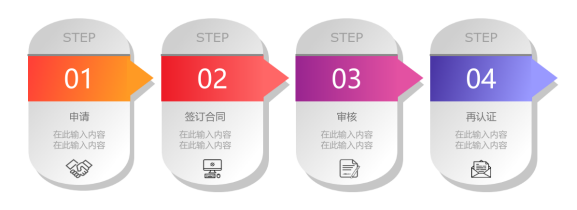
7. Key Points for Certification Preparation and Implementation
Beyond choosing a certification body, companies themselves also need to be well prepared:
documentation is the foundation: a complete set of system documents is required, including the food safety policy manual, procedure documents, the HACCP plan, prerequisite programmes (PRPs) and various operational records. Make sure the documented requirements are consistent with actual practice.
Full staff involvement is key: BRCGS Issue 9 places particular emphasis on "food safety culture". This means everyone, from management to frontline staff, must understand and put food safety requirements into practice. Regular training and awareness-raising activities are indispensable.
Watch the changes in the new issue: for requirements newly added in Issue 9 — such as food fraud prevention, management of food loss and waste, and hygienic design of equipment — companies need to assess their current status and prepare the corresponding assessment reports and control plans.
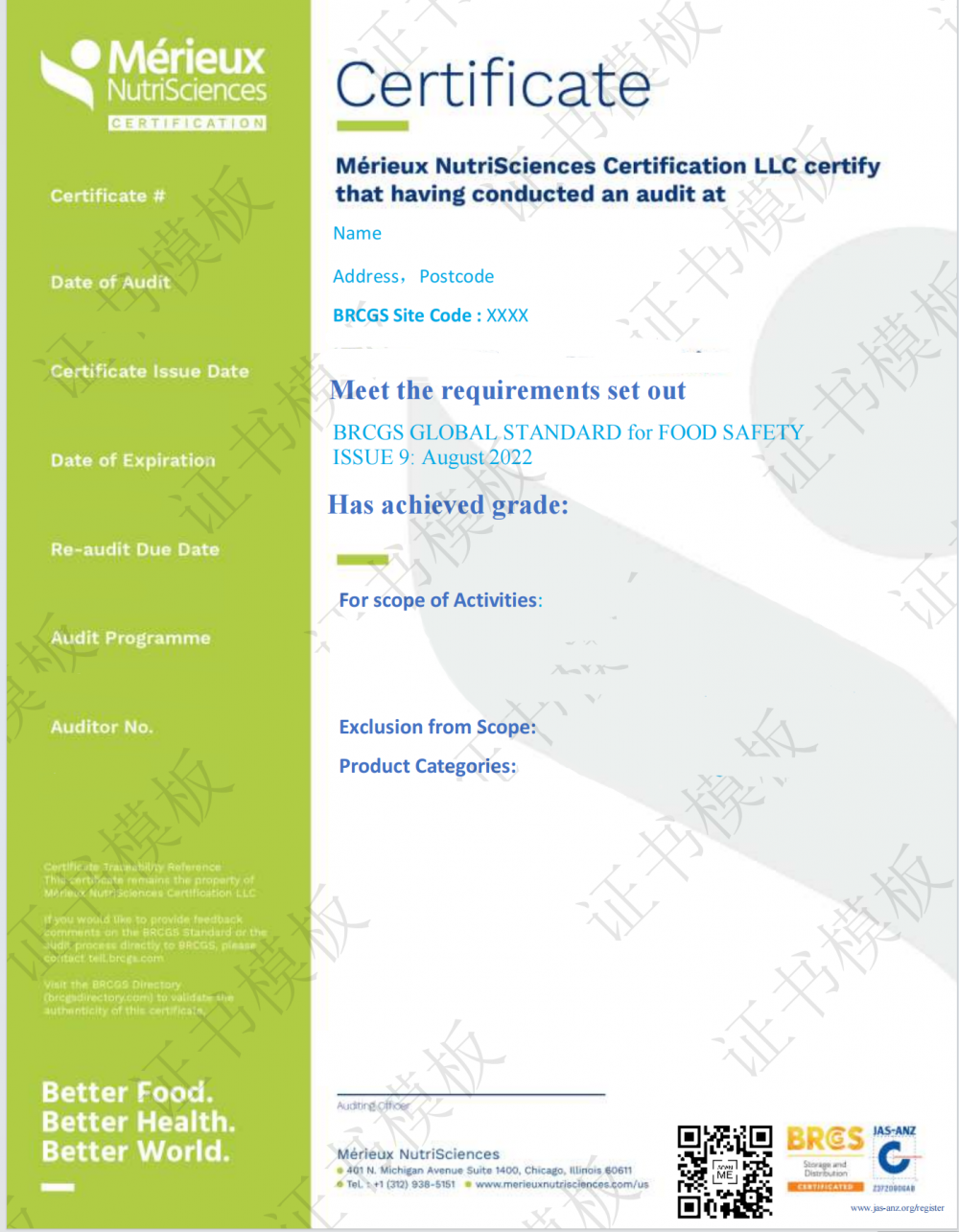
8. Certification Mark and Certificate
9. Certification Rules and How to Obtain Them
(1) Certification rules: BRCGS Food Standard (Issue 9).
(2) How to obtain: the above certification rules are owned by Mérieux Certification (Shanghai) Co., Ltd., which holds the right of final interpretation of the rules. No organization or individual may use the information relating to the certification rules, in whole or in part or in any form, without the written permission of Mérieux Certification (Shanghai) Co., Ltd., except where required by law.
(3) Fee schedule: for fee information, please refer to the Disclosure of Fee Standards of Mérieux Certification (Shanghai) Co., Ltd.
Address: Room 101, Building 3, No. 3576 Zhaolou Road, Minhang District, Shanghai
Postal Code: 201112
Tel: 021-6221 8815 / 021-6496 7600
Website: https://www.mxns.cn
Email: audit.china@mxns.cn