


ISO 9001 Quality Management System Certification
1. Certification Introduction
ISO, whose full name is the International Organization for Standardization, was established following a decision by representatives of 25 countries meeting in London to create a new international organization; it was officially founded on 23 February 1947 and is headquartered in Geneva, Switzerland. The ISO 9000 family is developed and revised by ISO/TC 176/SC 2 (the Quality Systems Subcommittee of the ISO Technical Committee on Quality Management and Quality Assurance). It is applicable to all enterprises that need to demonstrate their ability to provide products and services that meet customer and applicable statutory and regulatory requirements, and that seek to ‘enhance customer satisfaction’. The ISO 9000 family has undergone several revisions; the most recent was in 2015, when the ISO series was comprehensively upgraded to adopt ISO's high-level structure (HLS).
ISO 9001 is a highly mature quality framework, currently used by more than 750,000 organizations in 161 countries and regions. Drawing on the essence of a century of quality management theory and practice worldwide, ISO 9001 is a product of the market economy. The implementation and development of the ISO 9001 standard have contributed positively to helping enterprises and organizations improve their quality management and quality assurance capability, reduce operating costs, lower business risks and remove technical barriers to trade. For any organization — industrial, commercial or governmental — the purpose of perfecting its quality management is to exercise effective control over the quality of its products or services and to continuously improve that quality, so as to meet customer needs, earn their trust, expand market share, and promote the growth and development of the organization's overall performance.
Through third-party inspection, certification and international rules, ISO 9001 guides and disciplines enterprises and raises their level of management, enabling them, in a process of continuous self-improvement and self-development, to better meet customer needs and statutory and regulatory requirements. This third-party certifier is independent of the economic interests of both producers and sellers, and is impartial and scientific; it serves as a universal "pass" for the quality evaluation and supervision of products and enterprises across countries, and can also serve as the basis for customers to audit their suppliers' quality systems, demonstrating an enterprise's capability to meet the technical requirements of the products ordered. The ISO 9001 certificate is valid for 3 years, with annual surveillance audits and a recertification audit at the end of the validity period to issue a new certificate.
The ISO 9000 family meets organizations' need to perfect their quality management. Any product or service embodies customer needs through specifications or technical standards, and the creation and application of the ISO 9000 quality system filled this gap. Adopting the ISO 9000 family makes quality management standardized and quality activities procedure-based. Implementing ISO 9001 requires the establishment of a documented quality management system. The QMS makes detailed provisions on the scope and purpose of each activity — what is done, by whom, when, where and how, what equipment and materials are used, and how activities are controlled and recorded — so that every quality management activity follows established rules, that rules are invariably followed, and that violations are invariably corrected, achieving the shift from ‘rule of man’ to ‘rule of law’.
2. Certification Targets and Scope
All requirements specified in ISO 9001 are generic and are intended to be applicable to organizations of all types and sizes, providing different products and services.
Mérieux's current certification scope mainly covers the food sector: farming/breeding, food processing, catering services and related fields.
3. Benefits of Certification
(1) Standardizing internal management, emphasizing full staff participation, heightening employees' quality awareness, and improving operational efficiency and overall performance;
(2) Emphasizing a customer focus, meeting customers' evolving requirements and statutory and regulatory requirements, and increasing market share;
(3) Strengthening the stability of quality management, ensuring product quality consistency, optimizing quality costs, reducing quality losses and improving economic returns;
(4) Emphasizing continual improvement and comprehensively raising the enterprise's overall quality and level so that it keeps growing and expanding;
(5) Promoting international trade, removing technical barriers, aligning with advanced international management practices, and integrating into the globalized economy.
4. Certification Requirements
Certification model: document review + Stage 1 on-site audit + Stage 2 on-site audit + annual surveillance audits after certification; the certificate is valid for 3 years;
Basis: GB/T 19001-2016/ISO 9001:2015 Quality management systems — Requirements;
On-site inspection auditor-days and fee schedule: the number of auditor-days and the fees are determined according to the company's size, the scope and nature of the activities covered, technical complexity, the degree of quality and safety risk, and the number of effective personnel within the scope of the system; for specific fee information, please refer to the Disclosure of Fee Standards of Mérieux Certification (Shanghai) Co., Ltd.
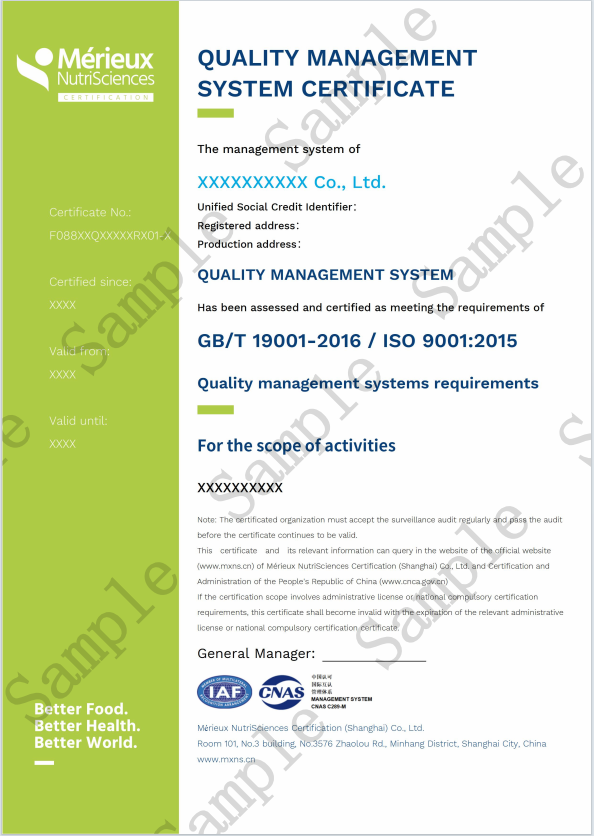
5. Certification Mark and Sample Certificate
6. Certification Rules and How to Obtain Them
(1) Certification rules: GB/T 19001-2016/ISO 9001:2015 Quality management systems — Requirements.
(2) How to obtain: the above certification rules are owned by Mérieux Certification (Shanghai) Co., Ltd., which holds the right of final interpretation of the rules. No organization or individual may use the information relating to the certification rules, in whole or in part or in any form, without the written permission of Mérieux Certification (Shanghai) Co., Ltd., except where required by law.
To obtain the relevant certification rules, please use the following contact information:
Address: Room 101, Building 3, No. 3576 Zhaolou Road, Minhang District, Shanghai
Postal Code: 201112
Tel: 021-6221 8815 / 021-6496 7600
Website: https://www.mxns.cn
Email: audit.china@mxns.cn