


ISO 22000 Food Safety Management System Certification
1. Certification Introduction
Entering the 21st century, consumers worldwide have demanded safe and wholesome food, and food processing enterprises have consequently had to implement food safety management systems to ensure that the food they produce and sell is safe.
To help these enterprises meet market demands, and at the same time to demonstrate that they have established and implemented a food safety management system and are thus capable of supplying safe food, the International Organization for Standardization (ISO) took advantage of the Codex Alimentarius Commission's (CAC) decision to defer developing HACCP guidelines for applying the ISO 9000 series, and on 15 November 2001 incorporated HACCP principles into ISO 9000, producing ISO 15161:2001, Guidelines on the application of ISO 9001:2000 for the food and drink industry. In 2005, the ISO technical committee for food products (ISO/TC 34) developed a food safety management system dedicated to use within the food chain, namely ISO 22000:2005, Food safety management systems — Requirements for any organization in the food chain, and on 15 June 2018 published ISO 22000:2018, which adopts ISO's high-level structure.
As economic globalization advances and society grows more civilized, people pay ever greater attention to food safety, and organizations that produce, handle and supply food are required to demonstrate their ability to control food safety hazards and other factors affecting food safety. Customer expectations and social responsibility have gradually led such organizations to recognize the need for standards to guide, safeguard and evaluate food safety management — and thus the food safety management system came into being.
ISO 22000 (FSMS) adopts the structure of the ISO 9000 standards and applies HACCP (Hazard Analysis and Critical Control Point) principles as the methodology throughout the system. It defines hazard analysis as the core of planning for the realization of safe food, taking the product characteristics, intended use, flow diagrams, process steps and control measures, and communication from the preliminary steps established by the Codex Alimentarius Commission (CAC) as inputs to the hazard analysis and its updating; it combines the HACCP preventive plan and its prerequisite conditions — the prerequisite programmes — in a dynamic, balanced way; and it extends food traceability as far as possible while identifying the vulnerable links along the entire chain. The standard can be integrated with other management standards, such as quality and environmental management system standards.
ISO 22000 applies the principles and methods of food technology, microbiology, quality control and risk assessment to evaluate hazards and risks across the entire food chain — from crop growing and harvesting, raw materials and ingredients, processing, manufacturing, transport and distribution, to preparation and consumption. It carries out a systematic and comprehensive analysis of potential hazards, identifies the "critical control points" at which hazards can be effectively prevented, reduced or eliminated, and then controls the hazardous factors at those points, ensuring food safety and hygiene and effectively eliminating food contamination. The ISO 22000 certificate is valid for 3 years, with annual surveillance audits and a recertification audit at the end of the validity period to issue a new certificate.
2. Certification Targets and Scope
All requirements specified in ISO 22000 are generic and applicable to all organizations in the food chain, whatever their size and complexity. Directly or indirectly involved organizations include, but are not limited to, feed producers, producers of animal food, gatherers of wild plants and hunters, farmers, ingredient producers, food manufacturers, retailers, organizations providing food services, catering services, cleaning and sanitation services, transport, storage and distribution services, and suppliers of equipment, cleaning agents and disinfectants, packaging materials and other food contact materials. Mérieux's current certification scope mainly covers food farming/breeding, food processing, food additives, catering services, and food storage and transport, and related fields.
3. Benefits of Certification
(1) Raising the level of food safety hazard control and strengthening systematic food safety management capability;
(2) Promoting compliance and demonstrating conformity with applicable food safety laws and regulations;
(3) Demonstrating conformity to the requirements of food safety stakeholders, strengthening the confidence of purchasers and consumers, and promoting acceptance by food safety regulators;
(4) Certifying against an international standard to promote international recognition and acceptance;
(5) Enhancing competitiveness and market image, and removing trade barriers.
4. Certification Requirements
Certification model:
document review + Stage 1 on-site audit + Stage 2 on-site audit + annual surveillance audits after certification; the certificate is valid for 3 years;
Basis:
ISO 22000:2018 Food safety management systems — Requirements for any organization in the food chain;
On-site inspection auditor-days and fee schedule:
the number of auditor-days and the fees are determined according to the company's size, the scope and nature of the activities covered, and the number of effective personnel within the scope of the system; for specific fee information, please refer to the Disclosure of Fee Standards of Mérieux Certification (Shanghai) Co., Ltd.
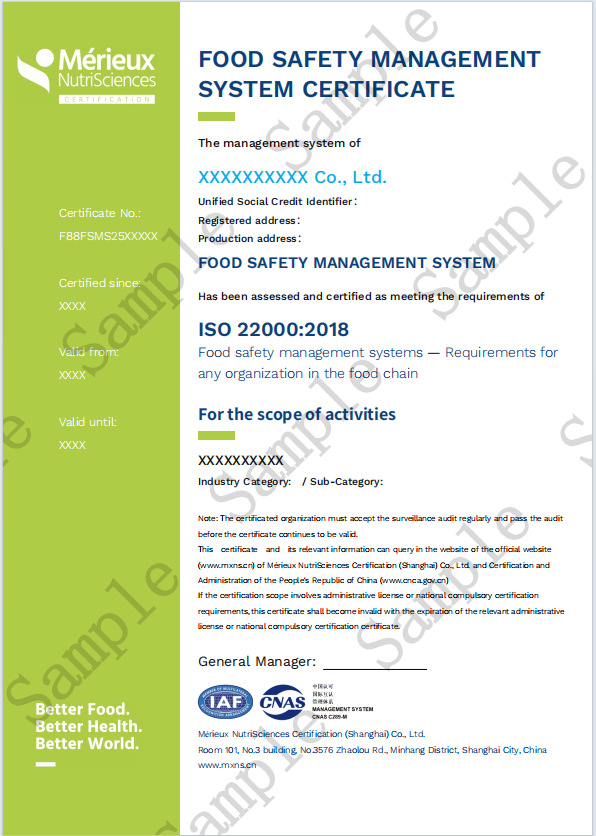
5. Certification Mark and Sample Certificate
6. Certification Rules and How to Obtain Them
(1) Certification rules: ISO 22000:2018 Food safety management systems — Requirements for any organization in the food chain.
(2) How to obtain: the above certification rules are owned by Mérieux Certification (Shanghai) Co., Ltd., which holds the right of final interpretation of the rules. No organization or individual may use the information relating to the certification rules, in whole or in part or in any form, without the written permission of Mérieux Certification (Shanghai) Co., Ltd., except where required by law.
To obtain the relevant certification rules, please use the following contact information:
Address: Room 101, Building 3, No. 3576 Zhaolou Road, Minhang District, Shanghai
Postal Code: 201112
Tel: 021-6221 8815 / 021-6496 7600
Website: https://www.mxns.cn
Email: audit.china@mxns.cn