


HACCP (Hazard Analysis and Critical Control Point) System Certification
1. Certification Introduction
Hazard Analysis and Critical Control Point (HACCP) originated in the United States in the 1960s, when Pillsbury and NASA applied a "zero defects" approach to controlling the hygienic quality of astronauts' food while developing space food — an effort that produced the HACCP food quality management system. The HACCP principles were presented at the first US National Conference on Food Protection in 1971, immediately accepted by the Food and Drug Administration (FDA), and adopted into the GMP for low-acid canned foods.
In 1974, the FDA published the incorporation of HACCP principles into the GMP for low-acid canned foods. In 1985, the US National Academy of Sciences (NAS) published its evaluation of the effectiveness of HACCP in food regulations.
Subsequently, the US National Advisory Committee on Microbiological Criteria for Foods (NACMCF) — composed of experts from four government agencies, namely the USDA Food Safety and Inspection Service (FSIS), the US Army Natick Research Institute, the FDA and the National Marine Fisheries Service (NMFS), together with universities and private organizations — adopted the seven HACCP principles for food production in 1992. In 1993, the FAO/WHO Codex Alimentarius Commission approved the Guidelines for the Application of the HACCP System, and in 1997 issued the revised codex guideline Hazard Analysis and Critical Control Point (HACCP) System and Guidelines for its Application. This guideline has been widely accepted and internationally adopted, and the HACCP concept is recognized worldwide as a benchmark for producing safe food.
In China, the aquatic products sector was among the first to embrace and introduce HACCP quality assurance methods. In 1991, the Fisheries Bureau of the Ministry of Agriculture sent experts to the HACCP seminar organized by the US FDA, NOAA and NFI. In 1993, the National Aquatic Products Quality Inspection Center successfully held China's first HACCP training course for aquatic products, covering HACCP principles, quality assurance techniques for aquatic products, and related hazards and monitoring measures. In 1996, in light of the export trade situation for aquatic products, the Ministry of Agriculture issued five industry standards, including that for frozen shrimp, and carried out extensive promotion and implementation, launching HACCP training at a larger scale.
In December 2002, the China National Accreditation Board for Certifiers (CNAB) officially launched pilot accreditation of HACCP system certification bodies and began accepting pilot applications. China's HACCP system initially used the CAC General Principles of Food Hygiene and the guidelines on HACCP principles and their application as its certification basis; as society continued to advance, China developed its own HACCP system certification standard — the latest version of CHINA HACCP being the Requirements for Certification of Hazard Analysis and Critical Control Point (HACCP) System (V1.0), issued in 2021.
The CHINA HACCP system is a standard recognized by GFSI as equivalent and is a scientific, preventive food safety system that must be built on prerequisite programmes. It overcomes the defects of traditional food safety control methods (on-site inspection and finished-product testing), emphasizes the management and control of the process itself, and thus controls food safety more effectively. The state therefore strongly encourages enterprises to pursue voluntary certification in order to raise systematic food safety management capability and promote its acceptance by food safety regulators.
HACCP applies the principles and methods of food technology, microbiology, quality control and risk assessment to evaluate hazards and risks across the entire food chain — from crop growing and harvesting, raw materials and ingredients, processing, manufacturing, transport and distribution, to preparation and consumption. It carries out a systematic and comprehensive analysis of potential hazards, identifies the "critical control points" at which hazards can be effectively prevented, reduced or eliminated, and then controls the hazardous factors at those points, ensuring food safety and hygiene and effectively eliminating food contamination. The CHINA HACCP certificate is valid for 3 years, with annual surveillance audits and a recertification audit at the end of the validity period to issue a new certificate.
2. Certification Targets and Scope
The HACCP certification standard is applicable to all organizations in the food chain, whatever their size and complexity. Directly or indirectly involved organizations include, but are not limited to, feed producers, producers of animal food, ingredient producers, food manufacturers, retailers, organizations providing food services, catering services, cleaning and sanitation services, transport, storage and distribution services, and suppliers of equipment, cleaning agents and disinfectants, packaging materials and other food contact materials. Mérieux's current certification scope mainly covers food processing, food additives, catering services, and food storage and transport, and related fields.
3. Benefits of Certification
(1) Enhancing reputation through compliance with relevant regulations and helping certified companies avoid regulatory violations;
(2) Increasing consumer confidence in products and enhancing their credibility among consumers;
(3) Reducing quality management costs and the nonconformity rate of finished products, improving product quality, extending shelf life, and greatly reducing the risk of producing and selling unsafe food;
(4) Increasing export and market access opportunities where certification is set as a market-entry requirement;
(5) Enhancing competitiveness and market image, and removing trade barriers.
4. Certification Requirements
Certification model: document review + Stage 1 on-site audit + Stage 2 on-site audit + annual surveillance audits after certification; the certificate is valid for 3 years;
Basis: Requirements for Certification of Hazard Analysis and Critical Control Point (HACCP) System (V1.0);
On-site inspection auditor-days and fee schedule: the number of auditor-days and the fees are determined according to the company's size, the scope and nature of the activities covered, and the number of effective personnel within the scope of the system; for specific fee information, please refer to the Disclosure of Fee Standards of Mérieux Certification (Shanghai) Co., Ltd.
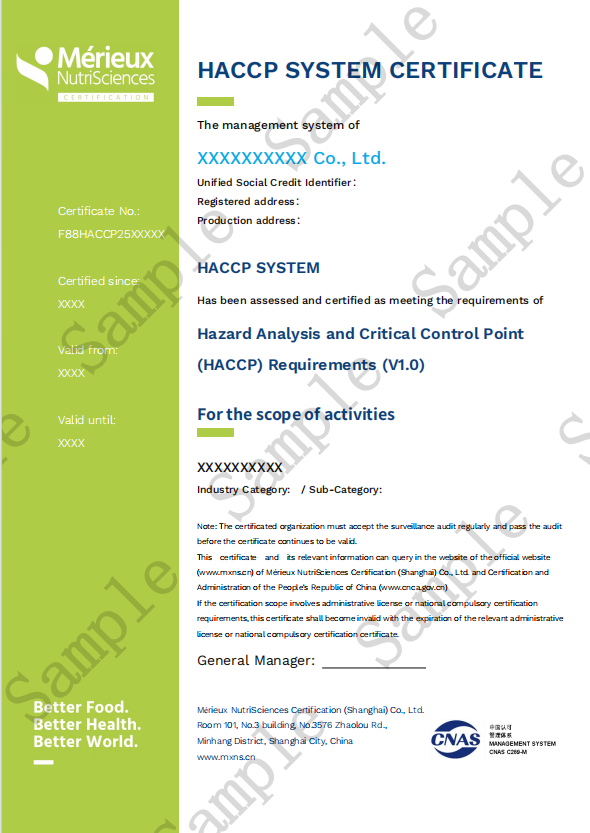
5. Certification Mark and Sample Certificate
6. Certification Rules and How to Obtain Them
(1) Certification rules: Requirements for Certification of Hazard Analysis and Critical Control Point (HACCP) System (V1.0).
(2) How to obtain: the above certification rules are owned by Mérieux Certification (Shanghai) Co., Ltd., which holds the right of final interpretation of the rules. No organization or individual may use the information relating to the certification rules, in whole or in part or in any form, without the written permission of Mérieux Certification (Shanghai) Co., Ltd., except where required by law.
To obtain the relevant certification rules, please use the following contact information:
Address: Room 101, Building 3, No. 3576 Zhaolou Road, Minhang District, Shanghai
Postal Code: 201112
Tel: 021-6221 8815 / 021-6496 7600
Website: https://www.mxns.cn
Email: audit.china@mxns.cn